Pickleball paddle delamination: causes, signs, and consequences
Published on October 22, 2026 Revised October 22, 2026 About 4 min
By the editorial team of Seconde Vie du Matériel.
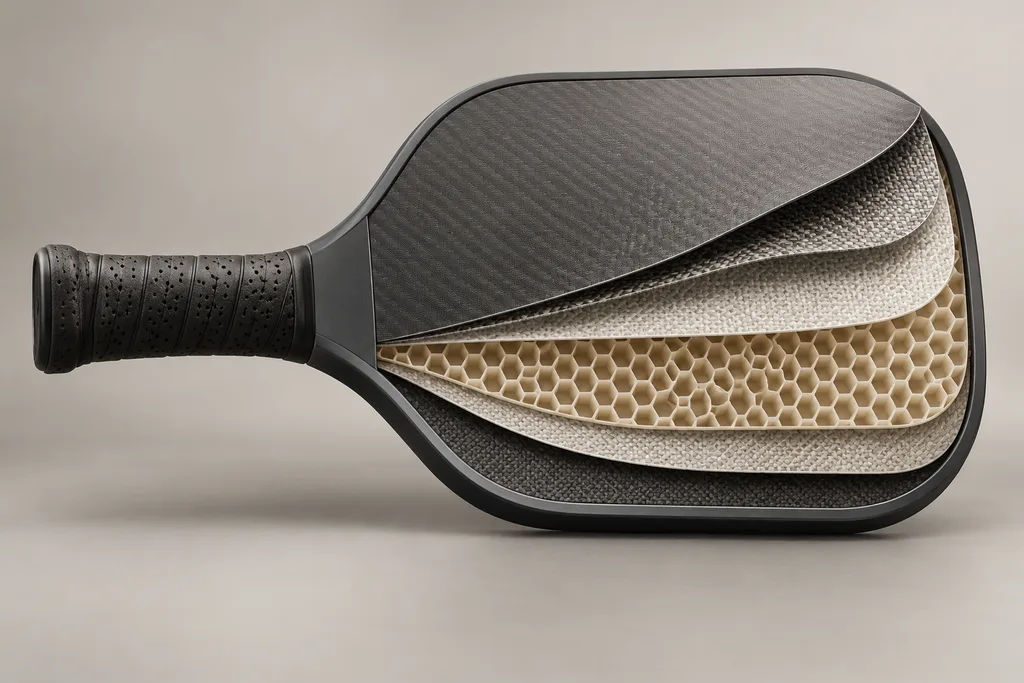
Time for "Pickleball paddle delamination: causes, signs, and consequences," a subject approached with good cheer and no jargon. It explains why the layers separate and why this changes how the ball behaves.
The key observations
The principle, simply: the FFT (the French tennis federation) obtained the ministerial delegation for pickleball in January 2026. A good landmark to connect with the following sections.
On the figures, the repair bonus has been usable since December 15, 2022 and is deducted from the invoice at a repairer holding the QualiRépar label; its amount ranges from 15 to 45 euros depending on the product.
A development worth noting: pickleball has been officially part of the Fédération française de tennis since January 1, 2026.
The first landmark to keep in mind: in a delaminated paddle, the glue holding the layers together breaks down; the layers separate and create a trampoline effect that increases the power of the ball.
The jargon, simple version
The key words of the subject, explained without jargon:
Legal conformity warranty
This is the protection set by law that requires the seller to deliver a conforming item and to repair or replace one that has a defect.
To picture it, here is an example: a new paddle delaminates after little normal use, and the buyer invokes the legal warranty with the seller.
The full entry for Garantie légale de conformité awaits those who want to go further.
The part in question
A rule worth knowing: a sticker or identification tape must not extend more than half an inch from the edge or more than one inch above the handle; a handwritten identification note is allowed.
On the official rules, a paddle that fails inspection must be replaced by an approved paddle, otherwise the match is lost by forfeit.
A rule worth knowing: the paddle must carry the USA Pickleball approval seal or sticker, as well as the brand name and model clearly marked by the manufacturer.
The points to compare
Here is the reading grid for deciding without hesitation:
- A visible crack on the face, the edge guard, the throat, or the handle is a reason to take the paddle out of competitive play.
- The United Pickleball Association recommends taking a paddle out of play when there is a visible crack on the face, the edge guard, the throat, or the handle.
- Besides hollow sounds, a spot that feels soft to the touch, an uneven surface, or inconsistent performance can reveal delamination.
- According to the 2025 USA Pickleball rules, the combined length and width of a paddle does not exceed 24 inches (60.96 cm) and the length alone 17 inches (43.18 cm); thickness and weight are not limited.
- A crackle that can be felt when pressing on the paddle face, or a rattling noise when shaking it, points to internal deterioration according to the United Pickleball Association guidelines (this is not an official rule).
The mistakes that keep coming back
Marking out the path: the traps to steer around are the following:
- In recreational play, there is no systematic check for delamination: it is up to the player to inspect the equipment personally.
- If a paddle's non-compliance is detected before the match, the player changes it without penalty; if it is detected after the match has started, the match is lost by forfeit.
What is delamination?
A clever move to remember: the 2025 USA Pickleball rules allow protective tape, weighted tape, and changing the handle size.
To close out the day
Head over to the neighboring pages of the site to keep exploring, without hurrying.
Your questions
Who should be contacted for the legal warranty?
The seller of the product, not necessarily the manufacturer. The detailed procedures appear on the service-public page.
Related articles
- Damaged paddle in a match: what the rules say — A damaged or repaired paddle and the rules of play. On the menu: the key points that frame it all, the core concepts, unhurried, and every guide article.
- Worn core or peeling face: telling which one is the cause — Diffuse wear can be told apart from localized peeling before deciding what to do next. Read in order, beginning with the magnifying-glass checklist.
- Dead paddle: sound, touch and visual signs to check — A few simple tests make it easy to recognize a paddle that has lost its responsiveness. On the page: the jargon, made simple.
- Warranty repair: step-by-step process for a defective paddle — Wording a request and knowing the applicable deadlines becomes straightforward. To read in order: the basics of the situation and the jargon, made simple.
Documents consulted
- Veolia accompagne l'essor du pickleball — French context: ministerial delegation to the FFT in early 2026, more than 30,000 regular players. Corporate communication: to be used for context only. Page consulted on 2026-10-19.
- Lancement du bonus réparation — Repair bonus created by the AGEC law, labeled repairers, announced extension to sporting goods. Page consulted on 2026-10-19.
- Nîmes : le premier club du Sud entièrement dédié au pickleball — Integration of pickleball into the FFT on January 1, 2026 and growth of clubs in France. Page consulted on 2026-10-19.
- What is a delaminated pickleball paddle? (PPA Tour) —
- Is my paddle legal for my first tournament? — Paddle inspection by the referee, USA Pickleball approved list, defects that invalidate it. Page consulted on 2026-10-19.
- The United Pickleball Association publishes guidelines for taking a paddle out of play —
- 2025 USA Pickleball Rules, Section 2: Court and Equipment — Summary of the paddle rules: dimensions, materials, hitting surface, permitted modifications. Information platform, non-commercial. Page consulted on 2026-10-19.
The conformity rules cited come mainly from USA Pickleball; in France, the FFT received the delegation for pickleball in early 2026, so check the rules of the competition in question.
A home repair can change how the paddle behaves and make it non-compliant in tournaments: when in doubt, ask the referee or the organizer.